| home | • | bookstore | • | boutique | • | contact us | • | news headlines | • | help! | • | share | • | site map | • | travel center |  |
 |
 |
 |
 |
|
 |
 |
 |
 |
 |
|||||
 |
|
|
|
|||||
| |||||||||||||||||||
| |||||||||||||||||||
| |||||||||||||||||||



|
|
|||
 French post offices (bureaux de poste or PTTs) – look for bright yellow La Poste signs – are generally open 9:00 a.m. to 7:00 p.m. Monday to Friday, and 9:00 a.m. to noon on Saturday. However, don't depend on these hours: in smaller towns and villages offices may close earlier and for lunch, while in Paris the main post office is open 24 hours. Avoid lunch hours and late afternoon, when office workers dealing with business mail create endless lines. 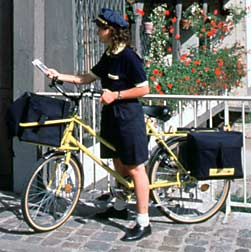
A French postal carrier delivering mail by bicycle. (click on image to see different version) © 2004 La Poste All Rights Reserved. France has the most concentrated postal network in Europe, comprising 17,082 public outlets; 5,632 of these are in partnership with other businesses, known as Agences Postales (postal agencies) or Relais Poste (postal intermediaries). In smaller villages, for example, it would not be unusual to find such services offered in a bakery or other private enterprise. 90% of French people live less than 5 km from a public outlet. All locations are listed in the phone book, under Administration des PTT in the Yellow Pages, and Poste in the White Pages. One can also search for a location online, by postal code or town. (Results will display the address, phone number, hours of operation, automated services, disabled access, and a street map.) General Delivery ServiceYou can receive mail at the central post offices of most towns. It should be addressed (preferably with the surname first and in capitals) "Poste Restante, Poste Centrale", followed by the name of the town and its postal code. To collect your mail you will need a passport or other convincing ID, and there may be a charge of around a euro or less. You should ask for all your names to be checked, as filing systems are not brilliant. Postal Codes in FranceAn essential part of all addresses in France is the five-digit postal code that identifies the commune. The postal code immediately precedes the name of the town or village, on the last line of the address for all mail within France. The first two digits of the postal code indicate the number of the département; and the last three digits identify the commune. Some communes are so small that they share the same code with one or more others. For example, 31620 is the postal code for nine different villages – including Fronton and Labastide Saint-Sernin – in département number 31, i.e. Haute-Garonne. (Click here to search for a postal code by town name.) For large cities with arrondissements (Paris, Lyon and Marseille), the last two digits of the postal code indicate the arrondissement; for example: 75009 PARIS means "Paris, 9ème arrondissement". 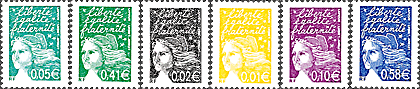 Postage Rates, Buying StampsFor sending letters, remember that you can buy stamps (timbres) with less queuing from tabacs (tobacco shops). Though many of the tabacs also sell postcards, the choice is limited; for a better selection of more unusual cards, try the Pompidou Center or the Latin Quarter (especially rue Saint André des Arts). Writing paper and envelopes may be purchased in papeteries (stationers), but most supermarkets offer the same at a much lower price. 
A standard first-class letter (20g or less, Lettre Verte) or postcard sent within France costs €0.58, or €0.63 by priority mail; to continental European countries (from Scandinavia to Portugal), Baltic states, Greece, and the British Isles €0.80; to other European or Eurasian countries (Iceland, Russia, etc.), Africa, the Americas, Asia, and Oceania (Australia, New Zealand) €0.95. (Refer to calculator for other countries, and/or weights above 20g.) Inside many post offices you will find a row of yellow-colored guichets automatiques – automatic postage machines with instructions available in English, where you can weigh packages and buy the appropriate stamps; sticky labels and tape are also dispensed. A machine can change notes into coins, so there is no need to queue for counter service. 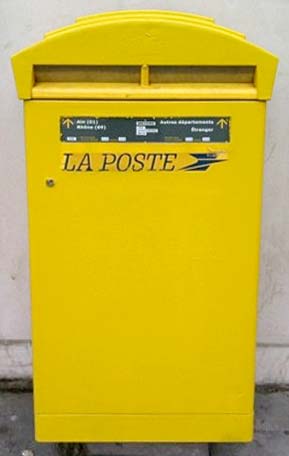
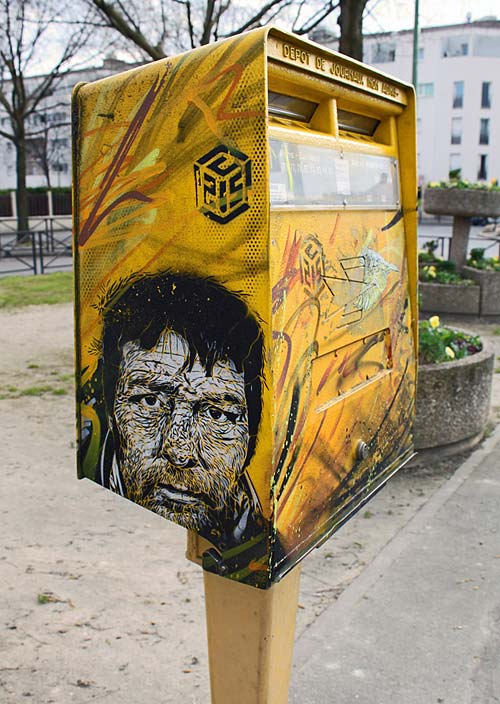
If you're sending parcels abroad, you can try to check prices on the guichet or in various leaflets available. Small post offices don't often send foreign mail and may need reminding, for example, of the discounts for sending printed papers and books. Other ServicesAt post offices you can also conduct your banking, change money, apply for credit, and receive fee-free financial services (see La Banque Postale), buy insurance, obtain photocopies, send faxes (télécopies) and make phone calls. To mail your letter on the street, look for the bright yellow postboxes. Central Post Offices in ParisIn Paris, the central post and sorting office of the Louvre is open 24 hours a day, but at night this is only for sending mail, poste restante (general delivery), telephones and telegrams.
Other central locations:
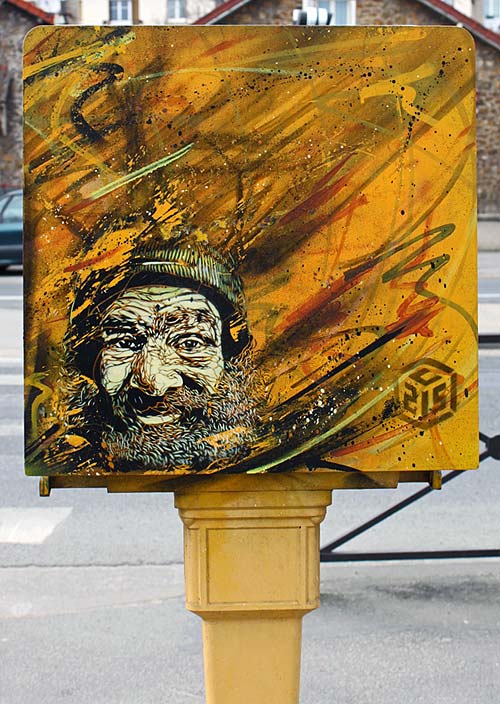
GO TO NEXT PAGE » Communications in France Editing and portions written by Ian C. Mills © 2001-. All Rights Reserved. Sources: (1.) Destination Guides © Rough Guides Ltd as trustee for its authors. Published by Rough Guides. All rights reserved. The Rough Guides name is a trademark of Rough Guides Ltd. Content reproduced here is licensed through Discover France's affiliation with certain travel providers. (2.) Égide Agency for International Mobility. Images: Postal carriers delivering mail by bicycle, © 2004 André Tudéla - La Poste. Yellow mailbox on the street (in lightbox gallery), photographer unknown, from ô ce cours: le blog des habitants du cours d'Herbouville. Artistic graffiti adorns yellow French mailbox in local park (and) Artistic graffiti adorns yellow French mailbox (rear view) (both in lightbox gallery), Marie Briand (photographer), from Flickr (1 & 2). All Rights Reserved. |
||||||

|
||||||||||





 Related Links