Address: Place de la Concorde, 75008 Paris
Métro: Concorde (lines 1, 8, 12); Bus: lines 24, 42, 52, 72, 73, 84, 94.
The Place de la Concorde is the largest public square in Paris. Situated along the Seine in the 8th arrondissement, it separates the Tuileries Gardens from the beginning of the boulevard Champs-Elysées. (see map) Originally named Place Louis XV, the square was designed by Jacques-Ange Gabriel, Louis XV's architect, for the purpose of showcasing an equestrian statue of the King — which had been commissioned in 1748 by the city of Paris and sculpted by Edmé Bouchardon.
| |
|
| |
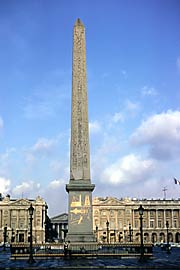
Obélisque de Luxor in the Place de la Concorde. To the left is the beautiful Hôtel Crillon, to the right is l'Hôtel du Ministère de la Marine (Naval Ministry). Between them, in the background, is the Madeleine at the end of rue Royale.
©1968-2008 Ian C. Mills.
Click on image for larger version (56k file). |
| |
Construction of the square began in 1754 and was completed in 1763. It is actually in the shape of an octagon, and was once bordered by large moats which no longer exist. The square marks an intersection of two axes: The major axis is that of the Voie Triomphale (Triumphal Way) which extends east-to-west in a perfectly straight line from the former royal palace (now the Louvre Museum), past the Arc du Carrousel and through the Tuileries Gardens, up the Champs-Elysées to the Arc de Triomphe, and beyond — now culminating at the Grande Arche in the Paris suburb of La Défense. The second (minor) axis is formed by the line between Place de la Madeleine, down rue Royale through the square and across the Pont de la Concorde, culminating at the Palais Bourbon.
Several decades after its construction, this square was to serve as a focal point for the bloodiest political upheaval in the history of France: the French Revolution. When the hordes of revolutionaries seized power, they renamed the square Place de la Révolution, tore down the statue of Louis XV and replaced it with a guillotine. Between 1793 and 1795, more than 1300 people were beheaded in public executions, including Louis XVI, Marie Antoinette, Danton and Robespierre. It is said that the scent of blood was so strong here that a herd of cattle once refused to cross the grounds.
Following the Revolution, the square suffered a series of transformations and several changes of name: place de la Concorde, place Louis XV (again), place Louis XVI, place de la Chartre, and once again place de la Concorde — symbolizing the end of a troubled era and the hope for a better future.
Today, the open-air square still looks quite similar to the way it did in the 1700s, save the actual ground — which now consists of tarmac and cement. Supplanting the guillotine is the powerful Obelisk of Luxor, a pink granite monolith that was given to the French in 1829 by the viceroy of Egypt, Mehemet Ali. The edifice, which once marked the entrance to the Amon temple at Luxor, is more than 3,300 years old and is decorated with hieroglyphics portraying the reigns of the pharaohs Ramses II and Ramses III. Gilded images on the pedestal portray the monumental task of transporting the monolith to Paris and erecting it at the square. Installed in 1833, the Obelisk — weighing 230 tons and standing 22.83 meters (75 ft) high in the center of the Place — is flanked on both sides by two fountains constructed during the same period. Having survived more than 33 centuries, the Obelisk has suffered the greatest damage during the past half-century by air pollution from industry and motor vehicles.
At each corner of the octagon are statues — created by Jacob Ignaz Hittorf — representing the French cities of Lille, Strasbourg, Lyon, Marseille, Bordeaux, Nantes, Brest and Rouen. (At one time, the pedestals under these statues were inhabited by citizens of Paris!) French sculptor Guillaume Coustou's monumental statues of the Horses of Marly — located at the beginning of the Champs Elysées — are copies of the originals which are now exhibited at the Louvre Museum. At the south end of the square, the Pont de la Concorde, built by Jean-Rodolphe Perronnet between 1787-1790 and widened between 1930-1932, crosses the Seine, leading to the Palais Bourbon — home of the French National Assembly (Assemblée Nationale).
Other places of interest which border the Place are the Galerie Nationale du Jeu de Paume (originally Napoleon III's indoor tennis court) and Musée de l'Orangerie, both in the Tuileries Gardens, and the Embassy of the United States — located in the corner of the square at the intersection of avenue Gabriel and rue Boissy d'Anglas.
Edited by Ian C. Mills
Sources: The Paris Pages, a web site hosted by Norman Barth, with research contributed by D. Dahl, H. Derks, O. Rakova, A. Uhlenbrauch, reviewed by Laurent Déchery - Gustavus Adolphus College, USA. Travelape/Paris, a web site hosted by Plexi Communications Inc., Ocean City, NJ. A View On Cities, a web site hosted by Kristiaan Van Ermengem. Paris History: La Voie Triomphale, a page on the WebMuseum-Paris web site, conceived by Nicolas Pioch.
Relevant publications: E.A. Wallis Budge, Cleopatra's Needles and Other Egyptian Obelisks (1990). Borel/Petrus, L'Obélisque de Louxor (1999 - in French). Labib Habachi, The Obelisks of Egypt: Skyscrapers of the Past (1985). Peter Tompkins, The Magic of Obelisks (1984). Manuel Minguez, Des Pyramides aux Obélisques: Les secrets des bâtisseurs égyptiens (1987 - in French). Daniel Arasse, The Guillotine and the Terror (1991). Morris Slavin, The Hebertistes to the Guillotine: Anatomy of a 'Conspiracy' in Revolutionary France (1994). Simon Schama, Citizens: A Chronicle of the French Revolution (1990). Christopher Hibbert, The Days of the French Revolution (1999).
Images: Obélisque de Luxor in the Place de la Concorde, and Pedestal Close-up of Obélisque de Luxor, ©1968-2003 Ian C. Mills, webmaster of DiscoverFrance.net — All Rights Reserved. Place de la Concorde, View of Obélisque de Luxor, from ClickArt Incredible Image Pack 65,000 © 1996 T/Maker Company (image enhanced by Ian C. Mills) — All Rights Reserved. Fountain in Place de la Concorde (Madeleine in background), from Ministère des Affaires Etrangères © F. de La Mure / M.A.E. — All Rights Reserved. Statue representing one of France's cities, in the Place de la Concorde, from Paris Images, ©1997 Christine Moisset, Department of Romance Languages, University of Pennsylvania, Philadelphia, PA — All Rights Reserved. Street map of Place de la Concorde area (including métro and bus stops), courtesy of RATP, the Paris transit authority.
History of Obelisks
An obelisk is a monolithic stone monument whose four sides, which generally carry inscriptions, gently taper into a pyramidion at the top. The ancient Egyptians usually erected them in pairs and associated them with the rays of the Sun, which increase in width as they reach the Earth. The earliest known examples, excavated at Abu Sir, Egypt, date from the Old Kingdom during the reign of Neuserre (2449-2417 B.C.). The unfinished obelisk in the quarry at Aswan shows how these monuments, some more than 32 m (105 ft) long, were cut as single pieces of red granite. Their transport on barges down the Nile is depicted on relief sculptures. So popular were these monuments among the Roman emperors that 13 of them were taken to Rome. Today, in addition to Cleopatra's Needles in London and New York, historic Egyptian examples stand in Paris, Florence, and Rome.
Robert S. Bianchi, Associate Curator, Department of Egyptian and Classical Art, The Brooklyn Museum, Brooklyn, N.Y.
Source: 2001 Grolier Multimedia Encyclopedia, ©2000 Grolier Interactive Inc. — All Rights Reserved.
| Place de la Concorde Links |
 |
|
|
360° Virtual-Reality Panorama
Paris Pour Vous offers a breathtaking view of the square and its surroundings, including the obelisk (with the Eiffel Tower in the distance), rue de Rivoli, and the Tuileries Gardens. (requires the Quicktime plug-in)
|
|
| Nominate A Site — Submit An Article! |
|
|
Place de la Concorde
Do you know of a great Place de la Concorde web page we should list here? If so, please submit it!
Are you an author, educator, student or traveler who would like to write an article for the enjoyment of our francophile community? Please download our author's guidelines (48K PDF). Thank you! |
|