| home | • | bookstore | • | boutique | • | contact us | • | news headlines | • | help! | • | share | • | site map | • | travel center |  |
 |
 |
 |
 |
|
 |
 |
 |
 |
 |
|||||
 |
|
|
|
|||||
| |||||||||||||||||||
| |||||||||||||||||||
| |||||||||||||||||||


|
|
|||
Opéra Bastille
In 1989, the Bicentennial of the French Revolution was marked by the inauguration of the Opéra Bastille, Mitterand's pet project and subject of the most virulent sequence of disputes and resignations of any of the grands projets. Almost filling the entire block between rues de Lyon, Charenton, and Moreau, this bloated building has totally altered the place de la Bastille. The Colonne de Juillet, which commemorates the later July Revolution of 1830, is no longer a pivotal landmark; in fact, it's easy to miss it altogether when dazzled by the nighttime glare of lights emanating from this hideous "hippopotamus in a bathtub", as one perceptive critic put it. The building might have been excusable as a new terminal building for the airport at Roissy, but here, in the capital's most symbolic square, it's an outrage. Internally, of course, the acoustics and stage vision of its 2700-seat auditorium are unrivaled – to get a seat you need to reserve months in advance. 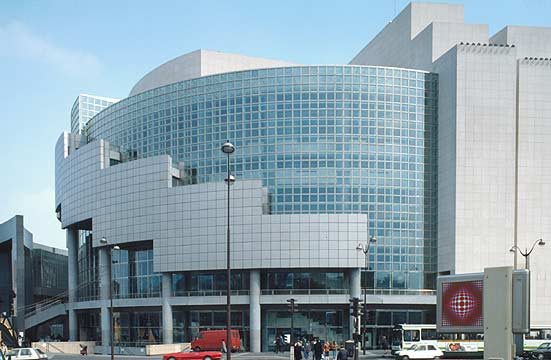 Opéra Bastille More than filling the site of the former Gare de Vincennes, the opera's construction also destroyed no mean amount of low-rent housing, and – as a result – the quartier de la Bastille is now trendier than Les Halles. The glass-and-metal paneled building was a product of an international design competition, won by Carlos Ott, a young Canadian born in Uruguay. Unfortunately, the specifications given to competitors required such sheer mass, that the bulky result could not possibly strike a harmonious note with the architectural context of its neighbors. Originally touted as a venue which would offer world-class-quality "opera for the masses" at a reasonable price, the Opéra has been plagued by musico-political infighting since its inception. Conductors came and left. There have been technical problems maneuvering the eleborate sets. Opera fans couldn't get used to the "surtitles" on a screen over the stage. Director Pierre Bergé ousted the star musical director, Daniel Barenboim, and replaced him with a relatively unknown Korean director, who is charged with living up to the Opéra's lofty and somewhat contradictory ideals. But now the National Opera has settled into its new home, and – under the baton of conductor James Conlon – the productions are both popular and critically acclaimed. The site's multi-functional performance space also hosts various concert and dance programs.
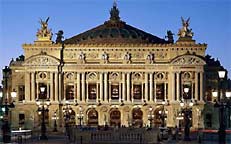
Opéra GarnierThe sumptuous and prestigious Paris Opera building, designed by Charles Garnier in 1861 and completed in 1875, is one of the largest theatre venues in the world. A lavish epitaph to the manic architectural activities of the Second Empire under Napoleon III, and aptly described as a "triumph of molded pastry," it lent a suitable image to the frivolity and materialism of the so-called naughty Eighties and Nineties.
The sheer mass of its stage – 11,000 square meters (or 118,404 square feet), with room for 450 players – seems to dwarf the respectable 2156-seat capacity auditorium, whose ceiling was painted in 1964 by Marc Chagall. At the Musée d'Orsay, one may view a complete slice-away maquette (model) of this amazingly ornate edifice, but anyone with an architectural gilt complex should make the pilgrimage to the glimmering marble-and-onyx Grand Staircase.
When the emperor and empress were presented with the model, the latter is reputed to have questioned, "What is this style? It's not a style. It's not Greek, it's not Louis XVI." Garnier allegedly replied, "No, those styles have had their day. This style is Napoleon III, and you complain?" In fact, the Opéra was constructed by the grand bourgeois more as a stage for self-display: its vestibules, galleries, stairs, anterooms, and other areas are much vaster than the mere auditorium for the select high society in attendance. Here one could stroll, step, sip, chat, ogle, and parade oneself in lengthy intermissions. That was the point, after all: the operatic performance itself was an intermission between obligatory social strutting. The personalities on view in the foyer and on the Grand Staircase were considered as important as the artists on stage singing Faust or La Traviata.
A few statistics are in order: the Opéra is 56m (185ft) high, 172m (568ft) long, and 101m (333ft) wide. The main chandelier weighs in at six and a half tons, while 19km (12 miles) of halls and corridors wind over several levels. It took 13 painters, 73 sculptors, and 14 plasterers and stucco specialists to achieve the opulent decor. The structure is built on top of an underground lake and stream, which persist beneath its cellars. The tale for the classic horror movie, The Phantom of the Opera, was set here. For an entry fee, you can stroll around the interior at your leisure (except occasionally during rehearsals). The Musée de l'Opéra, containing a few paintings and theatrical mementos, is unremarkable. Since the opening of the Opéra Bastille, the Opéra Garnier has devoted its repertoire exclusively to ballet. Though its productions are internationally renowned for their quality, they tend to remain on the traditional side of contemporary dance. Previously directed by the fiery Rudolf Nureyev, who walked out in 1990 in a cloud of controversy, the company is now run by the youthful danseur étoile Patrick Dupond. The Ballet de l'Opéra de Paris and the Opéra National de Paris schedule some performances here and some at the Opéra de la Bastille. In both venues, reduced ticket prices may be available at the box office 15 minutes before performance time for students and people under 25 or over 65. Opéra GarnierLocation: Place de l'Opéra, 75009 Paris.Phone: 01.40.01.23.34 (or) 01.47.42.53.71 (or) 01.40.01.22.63 Box office hours: 10 a.m. - 5:30 p.m. daily. Unguided tours: daily 10 a.m. - 5:00 p.m. Admission: Adults - € 7; students & under 19 - € 4. Web site: http://www.opera-de-paris.fr/ Métro: Opéra — lines 3, 7, 8. RER-A: Auber. Buses: Opéra — lines 22, 52, 53, 66; and RoissyBus (direct from CDG Airport). Théâtre Musical de Paris (Théâtre du Châtelet)Located at a hectic central crossroads, the place du Châtelet lies between the Pont au Change (which crosses to the Ile de la Cité) and the boulevard de Sébastopol. Once the site of an imposing fortress, Châtelet is known today for its vast underground métro station, where all lines and street performers seem to meet. Two identical theatres flank the square, whose center is marked by a sphinx-endowed fountain, erected in 1808, commemorating Napoleon's victory in Egypt. 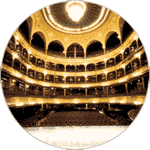
These theatres were built by Davioud in 1862, and each now leads a separate and even rival existence. The Châtelet concentrates mainly on opera and classical music, with occasional ballet, and usually has a rich program of international performers. (It recently acquired an annex in Les Halles, the Auditorium, where more unusual or obscure music is performed.) The other theatre, previously named the Sarah Bernhardt and now known as the Théâtre de la Ville, offers top names in contemporary dance, innovative French theatre, and evening concerts of jazz or world music. Before the Bastille Opera opened, and with the Garnier's transition to an all-dance programme, the TMP was the only Parisian venue offering a complete programme of high-quality opera. Despite the arrival of such a massive rival, the TMP has continued its ambitious schedule of progressive, well-made productions. Address: 1, place du Châtelet, 75001 Paris; phone: 01-40-28-28-98; fax: 01-42-36-89-75; Métro/RER: Châtelet.
Author: Ian C. Mills © 1998- – All Rights Reserved. Sources:
The Guide to the Architecture of Paris, Norval White, Charles Scribner's Sons/Macmillan Publishing Co., New York (out-of-print).
Frommer's Paris From $95 A Day, Jeanne Oliver, 1998, Macmillan Travel, A Simon & Schuster Macmillan Company, New York.
Fodor's Paris, Fodor's Travel Publications, Inc., published in the U.S. by Random House, Inc., New York.
The Real Guide - Paris (Revised), Kate Baillie & Tim Salmon, 1992, Prentice Hall, division of Simon & Schuster Inc., New York (out-of-print).
The TimeOut Paris Guide (2nd Edition), Penguin Books USA Inc., New York (out-of-print).
Fodor's Exploring Paris, Fodor's Travel Publications, Inc., New York.
The Columbia Dictionary of Quotations, Robert Andrews, Columbia University Press 1993. Images: Cover shot of "Charles Garnier's Paris Opera" from Amazon.com Books. Opéra de la Bastille exterior view, © Dave Ball (photographer), from HADAF Paris Field Trips Photo Album at Public Art Research Archive of Sheffield Hallam University, Sheffield, UK. Opéra Garnier exterior view, from Opéra de Paris. "Ballerina" © NAGR - Eurographics. – All Rights Reserved.
|
||||||||||||||||||||||||

|
||||||||||






 Opera & Ballet Links