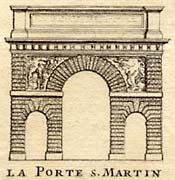
Two triumphal arches, at the Porte Saint-Martin and Porte Saint-Denis, were commissioned by Louis XIV to commemorate his military victories. Ever since 1670, reinforcement of France's northeastern borders had allowed the removal of fortifications surrounding Paris, and this circumference was transformed into verdant promenades. During the centuries that followed, they were to become the "grand boulevards"(1) of Paris.
Symbolically marking the entrances into 17th-century Paris at the sites of the old toll-gates, these two triumphal arches served only an ornamental function. Their sculptures and bas-reliefs celebrated the King as a head of war.
Construction of the Porte Saint-Martin immediately followed that of the Porte Saint-Denis in 1674, and it was likewise paid for by the city of Paris. A Latin inscription at the summit of the south façade proclaims, "To Louis the Great, for having vanquished the German, Spanish, and Dutch armies: the Dean of the Guild and the Aldermen of Paris."
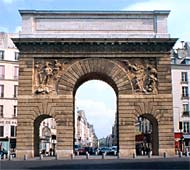
The two bas-reliefs on the south façade represent the taking of Besançon (see Province of Franche-Comté) and Louis XIV in the act of crushing the Triple Alliance. The north façade depicts the taking of Limbourg and the defeat of the Germans.
Although Louis XIV favored living at Versailles, he championed the urban development of Paris, instituting a Department of Roads to ensure that city streets were cleaner and well-lit.
Historical factoid: Saint-Martin once had its own métro stop, situated between Strasbourg-Saint-Denis and République. It was closed at the beginning of World War II (September 2, 1939) and reopened upon the Liberation of Paris (August 25, 1944). However, it was soon shut down again — this time permanently, judged to be too close to its neighboring stations. Saint-Martin is the largest of all closed métro stations in Paris, and still features the old porcelain tiled advertisements on its walls. In recent years, it has been put to use to house some homeless souls during the coldest winter months.
(1) The word boulevard is derived from an old German word bulwark, meaning the top surface of a rampart or the artery that replaces a rampart — which testifies to the military origin of its layout.
|
Location: Intersection of where rue St-Martin changes to rue du faubourg Saint Martin, and where boulevard St-Denis changes to boulevard St-Martin, 75010 Paris. Métro: Strasbourg-Saint-Denis (lines 4, 8, 9). Bus: 38, 39, 47. Admission: There is no public access to the inside or top of this monument. |
|
||
|
||
|
||
|
||
|
||
|

